Friday, May 8, 2020
SPARTAN Superway Wayside Power & Distribution 2019-2020 Final Presentation
The SPARTAN Superay Wayside Power & Distribution Team would like to thank all individuals, professors, and organizations who helped in making this project happen. Please see our final presentation here.

Thursday, April 30, 2020
Final Details
Over this week the Wayside time has been working on completing the project. The mechanical team has been putting the final touches on the assembly. The nuts and bolts are being determined and places in the assembly. The arm mechanism can be seen in figure 1. The electrical team has been working on the 2D schematic and brainstorming what else can be completed without access to physical prototyping tools.
Additionally, the team has been having more meetings throughout the week. We have been discussing how the presentation will be done. An outline for the presentation is being filled in by the teammates. The team has been planning how the paper will be written. All in all the Wayside team is working hard at completing the tasks at hand.
Written by Melody (Aryamitra Bake)
 |
| Figure 1. Arm mechanism with a linear actuator |
Additionally, the team has been having more meetings throughout the week. We have been discussing how the presentation will be done. An outline for the presentation is being filled in by the teammates. The team has been planning how the paper will be written. All in all the Wayside team is working hard at completing the tasks at hand.
Written by Melody (Aryamitra Bake)
Thursday, April 23, 2020
Closing in on Project Completion
As the academic year comes closer to an end the wayside power team has continued to finalize details on the project design. Details being finalized include subtle structural improvements and addition of new hardware and parts to create a design suitable for immediate application. Furthermore the team must power through may of the issues and details requiring attention. As a result the team has created a checklist and updated gantt chart to ensure certain important details are completed.


Written by Alex Ng

Even with the rapidly approaching deadline, the team strives to provide a realistic design with off the shelf components, however the team has found that not all components are suitable for application in the specialized design. As depicted in the image above a custom caster wheel was created to better fit specification requirements of the design. Below an image of the updated gantt chart is included.

Written by Alex Ng
Wednesday, April 8, 2020
Presentation 2 and Updates April 8, 2020
The team returned from spring break refreshed and ready for more work on the wayside project. We are improving our designs by adding wider t-slots, a more compact linear actuator, and track rollers for the third rail to ramp on and off. We got to show off our design work in presentation #2 click the link to view ==>(Presentation 2).
In the presentation, we discussed our specifications, the mechanical and electrical final designs. We also included what still needs to be done which includes designing safety guard rails and some final hardware. The team wanted to draw the electrical components and integrate all the wiring however, that will be too difficult under the time constraints so we have decided to only include electrical schematics. We do plan to include some assembly animations that show the bogie traveling down the rail to highlight how the conductor shoe contacts the third rail. Our presentation also included FEA on the bracket for that holds the conductor shoe mechanism and the track. The team is using a BoM for purchased materials and for needed materials if next year's team needs the information to build the design. We are under our allotted budget of $1000 by $58.81 in regards to what the team purchased already.
Written by Shane Sharp
 |
| Figure 1. Bogie with linear actuators and conductor shoe |
 |
| Figure 2. The first design with small t-slot and a large linear actuator |
 |
| Figure 3. The latest design with bigger t-slot, improved bracket, and smaller actuator |
Thursday, April 2, 2020
Spring Break Preparation
Since our previous meeting with Professor Furman and Ron, they gave us a lot of input on what we need to improve on our current design. Some of the problem that we need to take care of are materials upgrade, structural upgrade and electrical problem. Because of our current status of Senior Project, we are no longer need to take care of our budget, which means we can choose any materials that suitable for our project without worrying about the budget.
Some of the materials that we need to upgrade are the material for shoe box mechanism, use a larger double wide T-slot, larger linear bearing for the T-slot and a smaller linear actuator. There are also some structural upgrades that we need to keep in mind such as a wheel on the mechanism to prevent crashing, pivot point on the mechanism, resist twisting motion on the structure and also putting ribs on our L-bracket to support the structure.
For our electrical component, we are still trying to figure out how many current sensor and voltage sensor that we need and the location of it. We need at least two sets of sensors which are for the rail and the shoe pickup. We also need to contact the Power Module Team regarding what kind of connection that suitable to combine our project.
It is one week before spring break, the Wayside Power Team are preparing to decide what are we going to do throughout the break. On our meeting March 28, we decided on what we are going to do throughout the spring break. We also decided what time is most suitable for our meeting and work check in.
Written by,
Reynaldo Jahja
Thursday, March 26, 2020
COVID-19 Continues
Since the lockdown has been placed on California residents, the Wayside Team will no longer be meeting in person. The project will be completed virtually on Solidworks. There will be no more work done on the physical project. Thus the project now has the capability to expand beyond previous budget limitations. The Wayside team will have the ability to aim higher since the project can't physically be built. More robust material can be used in the assembly.
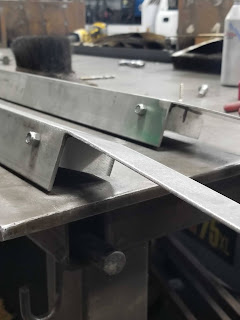
The mechanical team has decided to change the springs to constant force springs. Force sensors will be added. Adjustments will be made accounting for the wear on the contact shoe (Figure 1).
The electrical tabletop setup (Figure 2, 3) current flow issue has been resolved. The current flow issue we had previously was due to the power supply we were using. We switched out the power supply and now the system works.
The tabletop setup (Figure 2, 3) works and now the electrical team needs to work out how to scale up the system using a 36V power supply.
The electrical team will design 3D harnesses (Figure 4) for the assembly via SolidWorks Electrical. This will be accessed through desktop.sjsu.edu which gives access to ME lab computers. Electrical schematics will show where sensors will go.
Written By,
Aryamitra Bake
The mechanical team has decided to change the springs to constant force springs. Force sensors will be added. Adjustments will be made accounting for the wear on the contact shoe (Figure 1).
 |
| Figure 1. Arm mechanism |
The electrical tabletop setup (Figure 2, 3) current flow issue has been resolved. The current flow issue we had previously was due to the power supply we were using. We switched out the power supply and now the system works.
 |
| Figure 2. Tabletop setup |

The tabletop setup (Figure 2, 3) works and now the electrical team needs to work out how to scale up the system using a 36V power supply.
 |
| Figure 3. Tabletop setup |

The electrical team will design 3D harnesses (Figure 4) for the assembly via SolidWorks Electrical. This will be accessed through desktop.sjsu.edu which gives access to ME lab computers. Electrical schematics will show where sensors will go.
 |
| Figure 4. Example of 3D electrical harness |
Written By,
Aryamitra Bake
Thursday, March 19, 2020
COVID-19 Halts Wayside Power Progress
The Wayside Power Team continued to work on the project during the increasingly worsening pandemic. Unfortunately, for safety reasons the team will no longer be able to physically meet to construct the wayside power system. All project developments moving forward will be limited to design work.
Prior to the complete halt on physical development the team completed work on the third rails.
 The team also picked up linear actuators, however due to the unfortunate circumstances the team will have to follow the lock-down procedures and continue work remotely. The team will restructure the current project plan to proceed with predominately calculation and solid model work during remote work sessions.


Written by:
Alex Ng
Alex Ng
Thursday, March 12, 2020
Covid-19 Stalls Progress
Over the weekend, electrical team has begun researching the motor and motor controller left by the last year's team. The motor is a SOFN model from a company called XOFO. We will learn its mechanisms by reading any information from the manufacturer or the reports of last year. The motor controller is a Kelly Controls that can handle up to 48V motors. There are datasheets online for this controller and its interface. The problem will be in distinguishing the wires of the controllers interface and assembling a suitable housing for them. The mechanical team continued 3D printing shoe containers to perfect the CAD. We are planning to use a type of acrylic for the final containers, so the CAD must conform to those properties. The third rails will be almost fully assembled by next week, so the pictures below are only an update on what they look like this week.
During the weekdays of this blog, SJSU announced that the risk of contracting and spreading Covid-19 at school was too high, so they cancelled all classes for the week to prepare for the transition to fully online classes beginning next week. As a result, we did not meet in-person on Wednesday, but continued to work remotely. The 4 in. linear actuators that we ordered arrived, but they may be too large so we are debating on whether to go down to 2 in. The third rail is almost complete; they just need some more screws. The T-slot idea is still in the works. We need to find the materials that would make it possible.


During the weekdays of this blog, SJSU announced that the risk of contracting and spreading Covid-19 at school was too high, so they cancelled all classes for the week to prepare for the transition to fully online classes beginning next week. As a result, we did not meet in-person on Wednesday, but continued to work remotely. The 4 in. linear actuators that we ordered arrived, but they may be too large so we are debating on whether to go down to 2 in. The third rail is almost complete; they just need some more screws. The T-slot idea is still in the works. We need to find the materials that would make it possible.

Current state of third rails


XOFO's SOFN Drawings
Wednesday, March 11, 2020
Third rail update and shoe enclosure design update.
This last week has been very busy with the wayside power team. The team decided to order two 4" linear actuators with brackets that will be attached to the current collector shoe. Designs were finalized for the third rail assembly and brought to a welding shop in San Carlos, A & D Welding, so the aluminum and steel rails could be laid out and the holes drilled in them. On Saturday the holes were drilled in the rails by Shane. Further work on the rails includes countersinging the holes for the hardware after the hardware is provided and then assembly.
Further design work was done on the shoe encloser to add rigidity. The sharp corners were filleted, and side walls were added. End tabs with holes were also added for the lid attachment.
Work in the future includes final shoe mount fitting into the shoe enclosure, shoe lid design and fitment, design of the attachment method from the shoe to linear actuator to the bogie, and third rail assembly.
Written by Shane Sharp
Further design work was done on the shoe encloser to add rigidity. The sharp corners were filleted, and side walls were added. End tabs with holes were also added for the lid attachment.
Work in the future includes final shoe mount fitting into the shoe enclosure, shoe lid design and fitment, design of the attachment method from the shoe to linear actuator to the bogie, and third rail assembly.
 |
| Drawing of the aluminum rail |
 |
| Drawing of the stainless steel rail |
 |
| Image of the rendered shoe enclosure |
Saturday, February 29, 2020
The First Spring 2020 Presentation and Updated CAD
On Wednesday (02/26), the Spartan Superway Wayside Power Team were doing the first presentation of the ME 195B. After the presentation finished, the mechanical team and the electrical team are continuing to develop their works. The electrical team were working on the problem that they had last week which were not able sent current to the motor. Apparently, they found at that it was the wire issue. For the mechanical team, we were continuing on our work with the CAD design on the current collector.

They are working to integrate the arm mechanism to the bogie design from the last year team. The figures above are our work in progress assembly of our current collector. We are still determining the best linear actuator that we are going to use. The above figures of the linear actuator are just a CAD that we pull up from the actual McMaster shelves.
Written By,
Reynaldo Jahja
Thursday, February 20, 2020
Meeting with VTA and Continued Development of Shoe Mechanism
Wayside Power Team has continued to increase the work completed each week. In the most recent week the team was able to send Chuong, Ryan, Shane, and Alex to meet with VTA to learn about application and industry standards. The team was able to talk with Sr. Systems Design Engineer Alan Ng and Jr. Transportation Engineer Francisco Alolong, Jr.. Much of the meeting covered industry standards, application, technologies, and how the simple technologies were usually the easiest to maintain.
While some members met with VTA, the other members were able to spend some time working on the shoe mechanism. The team was able to produce a 3D print of the desired shoe clip shape with the recently acquired shoes.

Unfortunately the shoe clip is not to the exact desired specification, so the team will have to revise the design to better fit some of the unforeseen problems in the current shoe clip design. A lot of design needs to be tested before completion as such the wayside power mechanism has much work before completion.
Written by:
Alex Ng
Wednesday, February 12, 2020
Development of Electrical and Mechanical Systems
On Thursday (02/06), Waylon and Melody discussed how to hook up a 24V power supply to a motor driver. They also discussed how to test the power transfer from the rails to the motor. Waylon looked for parts to buy for a voltage converter. Shane and Reynaldo went over designs, drawings, and parts. They redrew the existing platform to represent the actual track. They discussed possible designs for the conductor shoe mechanisms. Reynaldo modeled the track, adding insulators and aluminum rails. Shane assisted Reynaldo in specs of the drawings and looked up current sensors from Pololu that may be useful in the project to gather electrical current data.
On Sunday the team met and discussed what needs to be purchased for the electrical system. Two linear actuators, hall effect sensors, strain gauges, and voltage sensors need to be ordered. For the measuring system, the team will be using a Hall Effect Current Sensor ACS758 (50B Version) and LCD display. Melody and Waylon used draw.io to make the electrical schematic below (Figure 1).
The mechanical team discussed the shoe arm mechanism. A single pivot point connection to the linear actuator will be used. The linear actuator stroke length will be 2”-6”. There will be one strain gauge on the center sliding shoe contact. The necessary force for the spring will be calculated. It was estimated that 6 PSI is required for the shoe. Next up the team will be assembling the steel cap and ramps.
Written by,
Melody (A. Bake)
On Sunday the team met and discussed what needs to be purchased for the electrical system. Two linear actuators, hall effect sensors, strain gauges, and voltage sensors need to be ordered. For the measuring system, the team will be using a Hall Effect Current Sensor ACS758 (50B Version) and LCD display. Melody and Waylon used draw.io to make the electrical schematic below (Figure 1).
 |
| Figure 1. Electrical Schematic |
The mechanical team discussed the shoe arm mechanism. A single pivot point connection to the linear actuator will be used. The linear actuator stroke length will be 2”-6”. There will be one strain gauge on the center sliding shoe contact. The necessary force for the spring will be calculated. It was estimated that 6 PSI is required for the shoe. Next up the team will be assembling the steel cap and ramps.
Written by,
Melody (A. Bake)
Wednesday, February 5, 2020
Enhancing our designs
We are continuing to improve our electrical test station, track design, and actuator design. The electrical test station required some new wires and terminals to reach the power supply. We are using a power supply that can output more than 20V to account for voltage drop through the rail. The test shoe wooden bar was given another wooden block that provides a snug fit on the test rails. Shane found some aluminum in the engineering yard at school. We will be able to use this aluminum for the large portion of the track. Steel can be capped onto the aluminum to improve wear resistance. However, our order of conductor shoes were lost in delivery. We will have to hunt down those shoes for now. The shoe container material has not been determined yet, but it must be flexible and an insulator. Design of the linear actuators includes how to attach them onto the bogie. We are in the process of CADing the attachment and deciding on its material. The linear actuators do not need to be large, we are thinking about 2-6 inches, but they have to be strong enough to hold the forces we want and be able to compensate for changes in the track.
Electrical Test Station
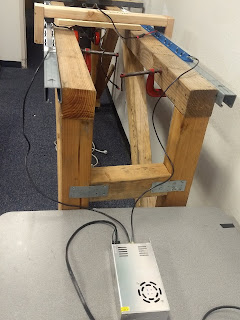

Electrical Test Station

Aluminum bar resting on Insulator (missing brackets under insulator and the middle layer is wood which is acting as a placeholder)

Thursday, January 30, 2020
Spring 2020; Hitting the ground running!
The new semester has begun and our team has some serious work to do. Over the winter break, we were able to finish the 30-foot track and dismantle the battery pack from last year's project. This way we can use the bogie to mount our current collector mechanisms. Today we purchased Helwig elctrographite brushes from eBay. They are a lot cheaper compared to the supplier. Helwig's price is $58.20 each, however, we found an eight pack for $90 on eBay. These brushes are grade H51 which provide 3200 PSI in strength, low resistivity, and an 80 amp current rating. Electrographite brushes are commonly used in high-speed motor applications with high current densities. Our current specs are approximately 33.4 amps, so these brushes will meet the requirements. Additionally, we designed brackets that hold the brushes in the collector shoe. Our next steps include researching appropriately rated springs that will provide pressure on the brushes to contact the third rail, designing an enclosure for the multiple brushes, and 3D printing the bracket and enclosure to ensure the design will work. Also, we are working on testing the current transfer from the third rail to a 12-volt motor using an Arduino and motor driver. This will be done using the brushes from last year's projects and a 12-volt power supply. After this is successfully tested, the team will scale up to 36 volts and test a bigger motor.
 |
| Helwig Elctrographite brush. https://www.helwigcarbon.com/shop/70-622091/ |
 |
| 30-foot track complete |
 |
| Bogie stripped of the battery pack and ready for the current collector |
Wednesday, December 4, 2019
End of Fall Semester
 |
| Figure 1. 30ft straight guideway |
Over the Thanksgiving break, Shane and Alex picked up the lumber and wooden stands. They built a 30ft straight guideway as shown in Figure 1. Next, we will need to level and straighten the guideway. We will need to adjust the width between the rails. The aluminum and steel third rail materials will need to be bought and added to the guideway.
It is the week before final exams. The Wayside team has been working on the electrical system development. More will be done over the winter break. Further work will be done on the conductor shoe mechanism design.
Written by,
Aryamitra Bake
Thursday, November 28, 2019
Narrowing Down Wayside Power Project Details
 |
| Figure 1: Wood materials and saw horses that will be used to construct the track. |
Progress on the full-scale prototype project has steadily picked up in speed. We have begun picking-up materials to build the full scale prototype track. The team has established that it will move away from using the induction motor bogie and instead use the previous team's bogie chassis.
Since the end of Fall Semester is quickly approaching the team has struggled to maintain the steady progress necessary to complete some of the project development as initially anticipated. However, after finals the team will continue development throughout the winter recess period.
Written by:
Alex Ng
 |
| Figure 2: The previous team's bogie chassis the team will be modifying and using on the new track. |
Written by:
Alex Ng
Sunday, November 24, 2019
This week our team presented our current progress and goals for the Superway project. Other work included continued development on a small scale model for testing our power concepts. The team is planning to build a 10-meter track in the Superway design room. The team is also working on building the supply current and current sensors so that we can prove the collector shoe is transferring the proper amount of current from the third rail.
Our presentation can be found here.
Our presentation can be found here.
Thursday, November 14, 2019
Prototype parts CADs
On November 10, The Wayside Power and Distribution Team continue our meeting on the Spartan Superway Facility. On this day we are continuing our works on the CAD design and also working on our Bill of Materials (BOM). The team is working on the new CAD design which is imitating the design of a rail track.
Furthermore, the team is having a debate about whether the guideway material needs to be an L bracket steel or it is unnecessary. After we are looking at the cost-effectiveness and how the design will be fit in our overall wayside power, we decided that we change a bit of our rail design from a combination of L bracket steel with a wooden board to all wooden board for the rail.
 |
| Figure 1, The overall looks on the new CAD design |
 |
| Figure 2, The new guideway design |
Wednesday, November 6, 2019
Continued Progress on Rapid Prototype
The Wayside Power and Distribution Team continues its progress in building a rapid prototype. This past week, on November 6th, the team presented at the Pod Car City Conference to various parties from universities and companies interested in pod car development. The conference was relatively successful and enabled teams and companies to spread their ideas and development progress.
At the team's current state we are set to gather materials and begin work on the rapid prototype once the team completes a bill of materials and gets approval from Professor Furman to purchase needed materials. Additionally the team updated some of the CAD items for the rapid prototype to a more realistic visual of what the rapid prototype will look like when completed.
At the team's current state we are set to gather materials and begin work on the rapid prototype once the team completes a bill of materials and gets approval from Professor Furman to purchase needed materials. Additionally the team updated some of the CAD items for the rapid prototype to a more realistic visual of what the rapid prototype will look like when completed.
 |
| Figure 1: Rapid prototype CAD with a half third rail setup. |
Recently the team had some difficulty and disagreements upon whether the rapid prototype should be completed in conjunction with the Bill's and Ron's half scale project. However the team has decided to steer away from additional dependence on other teams to reach the appropriate completion date.
 |
| Figure 2: Shoe mechanism rapid prototype design. |
Written by:
Alex Ng
Alex Ng
Thursday, October 31, 2019
October 31st Update
 |
| Figure 1. Shoe design idea |
the team contacted Helwig. We got a good response from them and so we will keep in contact with them. Both companies mentioned three-phase systems. We wonder if they're using an AC system on their Wayside. Additionally, VTA was contacted and they use bronze shoes and that is the reason it is so loud/noisy. We will be using graphite shoes.
Additionally, Shane and Alex will be attending the Pod Car City event on Monday to speak with VTA. Alex will represent our team on Wednesday by briefly explaining what our team is doing for Superway. Melody will be on a panel on Wednesday representing Spartan Superway.
Written by,
Aryamitra Bake (Melody)
Subscribe to:
Posts (Atom)
-
The SPARTAN Superay Wayside Power & Distribution Team would like to thank all individuals, professors, and organizations who helped in m...
-
 We are continuing to improve our electrical test station, track design, and actuator design. The electrical test station required some new w...
-
This past week we met on Saturday and a smaller group on Tuesday. On Saturday, we delegated topics for the coming presentation on 10/23. Sha...